Hi there! Some bits about me, my interests, and activities:
In the early 2000s I got interested in topics such as cyborgism, transhumanism, space colonization, life extension, and singularitarianism. From 2004 to 2009, I blogged on these in my futur:plom blog. Since 2009, texts of mine on more present-day techno-social phenomena and politics appeared in various outlets – such as carta.info and some books. At the same time, I started to do talks on such topics, and seminars for the DGB Bildungswerk. Lately though, I got bored with some lack of futurist wish-fulfillment: How slowly we're getting rid of basic pains when, techno-logically, we could – such as, globally, hunger and material poverty. That we suppress technology to explore and expand our minds – consider psychedelics. That we still coerce people to labors that could now be done by machines. That we create new scarcities instead of abolishing them – as in the field of "intellectual property". It seems to me now the hurdles lie not in science or technology, but in social and economic structures that restrict their potentials. That shifts my interest towards political utopianism. I've started to read on alternative economies and proposals for future ones.
I like movies – especially old and experimental ones. From 2004 to 2007, I attended Film Studies at the Freie Universität Berlin (no degree). Until 2009, I tried my hand as a film critic for some online magazines – mostly on fudder.de. (I've sort of given up on that career path for now.) At the same time, I blogged on cinema and television on my sites cine:plom and cine:tv:plom. From 2006 to 2008, I organized regular film nights at the TiK: One series enabled amateur short film makers to showcase their works. Another featured silent short films from the Cinema of Attractions era (1895-1907) – with sound effects and music by the theatre's ensemble, and historical introductions by me. (Since then, my curatorial activity has mostly shrunk to regularly doing private movie nights with some friends over.) At times, I've done minor film experiments of my own, and also contributed a bit to some monochrom movie projects.
Since my first steps into the Usenet in the 1990s I've been interested in online subcultures and their modes of expression (slangs, memes) and social organization patterns (such as newsgroups, IRC networks, imageboards). In the late '00s, my cine:plom blog (original focus: cinema and television) turned more and more to a study of meme and imageboard culture. I did a number of talks on those topics, and some podcasting, in 2012 explored them for the research project "Digital Self", wrote a book with erlehmann in 2013, and in 2018 mentored a research residency. In 2012 I also wrote an analysis (and comparison with 4chan) of the GUROchan imageboard for the Arse Elektronika 2009 anthology.
Since I got my first computer, I have at various times tried my hand at programming. From this, various amateurish attempts at software emerged. Over the years, I've accumulated a modest knowledge of Unix-like systems, and done stuff in C, Python, shell scripts, JavaScript, XSLT, Go, PHP, Rust, and even some ASM. In 2015, I enrolled as a Computer Science student, did some small coding jobs for MNT, and then got hired as a "software engineer" by e-commerce start-up Talon.One. I quit by the end of 2016, freelancing since them – among others for teledisko, and again and again for MNT. I've also tried my hand as a programming teacher, and wrote some software guides.
In 2013, I became interested in "roguelikes": descendants of the 1980 Unix game Rogue. In most roguelikes, player characters explore dungeons, fight monsters, collect and use items. Gameplay is usually turn-based. The world is shown in a top-down view – often as ASCII symbols. Worlds are generated "procedurally" – randomly anew on each game run. Old savefiles cannot be re-loaded, player character death is permanent - so one must play with care and strategy. Such features intrigued me. So I started coding my own roguelike engine: PlomRogue. It's growing slowly, and every few years I throw away everything to re-write it from scratch in some other language. But I learned a lot, and documented some my learnings in a dedicated PlomRogue Development Blog. In 2015, I wrote a first game for my engine: the ecological simulation Please the Island God. A second one appeared in 2016: the bodily functions/fluids adventure The Crawling Eater.
One issue I've worked on a lot is "post-privacy": the dissolution of privacy in the digital age; ethical and political evaluation of that change; and methods to deal with it, fight it, or even use it for good. I tried to develop some counter-arguments to privacy talking points common in the digital politics sphere: focusing on the ambivalent history of privacy as a bourgeois institution; criticizing of many promises of privacy activism; arguing for the value in broadening of transparency and inter-personal communication. Between 2008 and 2015 I've expounded such positions in various articles, on the radio, in talks – and a whole book. In my PlomWiki, I experimented with making public large parts of my own life – such as my personal finances, possessions, and daily routines. Nowadays I've grown very much bored with the whole "post-privacy" topic: Having repeated myself hundreds of times, I'd prefer not to be asked about it anymore.
In 2013, I decided to improve (or rather: set up) my Latin and Ancient Greek skills. I didn't get very far. I started with compiling declension tables, pronunciation rules and the like. But that quickly got confusing, most of all for Ancient Greek with its many dialects and stages of development. I then had a questionable idea on how to make these complexities more accessible to me: unravelling them back to the start by studying both languages' common ancestry – down to the Proto-Indo-European language. I got Sihler's Comparative Grammar of Greek and Latin and tried to put it into a form I could understand. But the subject matter was overwhelming. So I decided to work myself through an introduction first: Fortson's Indo-European Language and Culture. Up until around 2015, I hoped to systematize my learnings from that into a useful Indo-European studies wiki or the like. I wrote XSLT code to generate comparative tables of the various histories of Indo-European declensions, but never got too far with the actual data collection and systematization.
Since the 2010s I've become more involved with cultures and events of hedonism, hippies, burners, festivals, party scenes. I'm a bit too anhedonic to fully throw myself into the pleasures they offer. But I find some comfort and hope for humanity in them. I'm greatly interested in their politics, some of which I consider promising, some of which I consider dangerous. I'm most happy in these scenes when I find some limited way to make myself useful for their organization or maintenance.
I somehow managed to get two IMDb profiles: this one and that one. If anyone knows how to fuse them, please tell me.
My current PGP/GPG key (for plom@plomlompom.com) can be found here: plomlompom.asc.
I can often be found on freenode as plomlompom (name is NickServ-registered, but I don't always properly identify to NickServ), at the channel #zrolaps for example. But my avatar being online does not necessarily indicate me currently reading what's happening there.
Please note: Only for visits with an appointment, and sending me mail. I do not answer to door bell ringing when I do not expect visitors.
Christian Heller
Thaerstr. 43
10249 Berlin, Germany
Please note: I prefer communication by e-mail. I only answer the phone directly on calls that I expect. Other calls are put through to my mailbox. I listen to my mailbox regularly, but I rarely answer calls to it right away.
+49 30 31987477
Bank: Deutsche Kreditbank AG
Account holder: Christian Heller
IBAN: DE50120300001050296803
BIC: BYLADEM1001
BitCoin: 1LgtRNrXr7FyxbqWSrRDjXtMJsLQd8uoo6
DogeCoin: DTccEgXpvMKMU2xj4BDrPEc6tmqP2y8zW2
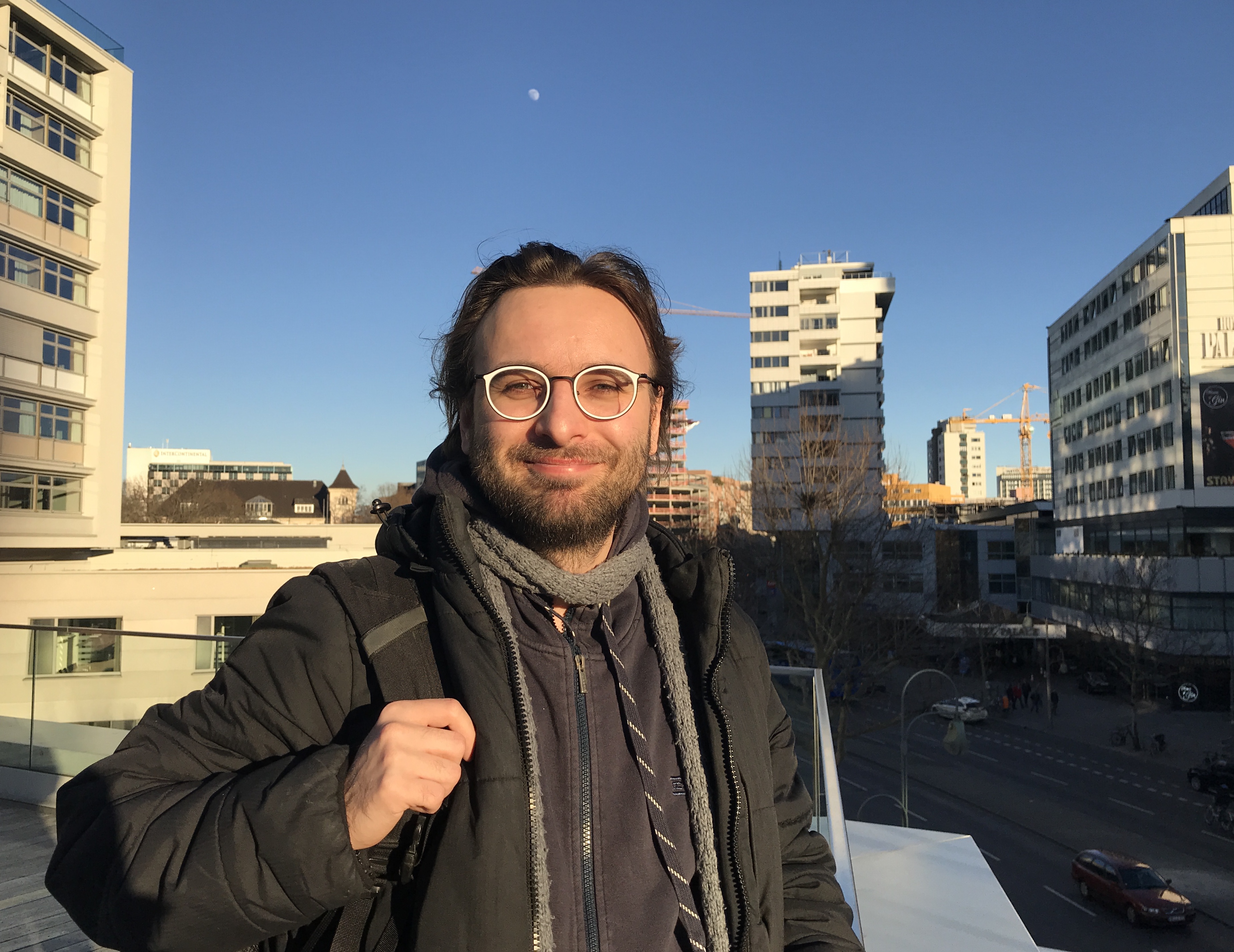
The following high-resolution photographs depicting me may be distributed under a Creative Commons Attribution 4.0 International Licence. Feel free to use them for whatever purpose under the terms explained behind that link, naming their respective creators:

active social networking accounts